Zinko
An open-source tracking auditor for GA4, Google Ads, Meta Pixel, and consent mode. It finds what's broken, shows the request that proves it, and explains the fix.
- Year
- 2026
- Role
- Author and maintainer
- Stack
- TypeScript, Effect, TanStack Start, Cloudflare Workers, Postgres, Python
The problem
A client says their conversions don’t match. Finding out why usually means opening Tag Assistant or Omnibug, clicking through the site once per consent choice, and building a spreadsheet of what fired where.
The tools that automate this tend to fall short in one of a few ways. Some need an install on the client’s site. Some read the tag configuration instead of what the browser actually sends. Some only cover Google tags. The rest are managed services priced for enterprises. I couldn’t find an open-source tool that records what really fires, across vendors and per consent choice, from outside the site.
What it does
You add a site and choose its start page plus up to 19 key pages. Zinko loads each one in a real browser under each consent choice: no interaction, accept all, reject all, and Global Privacy Control. It does this on desktop and mobile, with or without test click IDs. Each run records every tracking request, dataLayer push, cookie, and consent signal.
From that capture you get:
- Findings from 28 deterministic checks across consent, click IDs, event coverage, duplicates, deduplication, and hygiene. Each finding links to the request, cookie, or
dataLayerpush that proves it. - A tag matrix of every vendor and destination ID, showing what fired on which page under which consent choice.
- A hit explorer with every decoded request on a timeline.
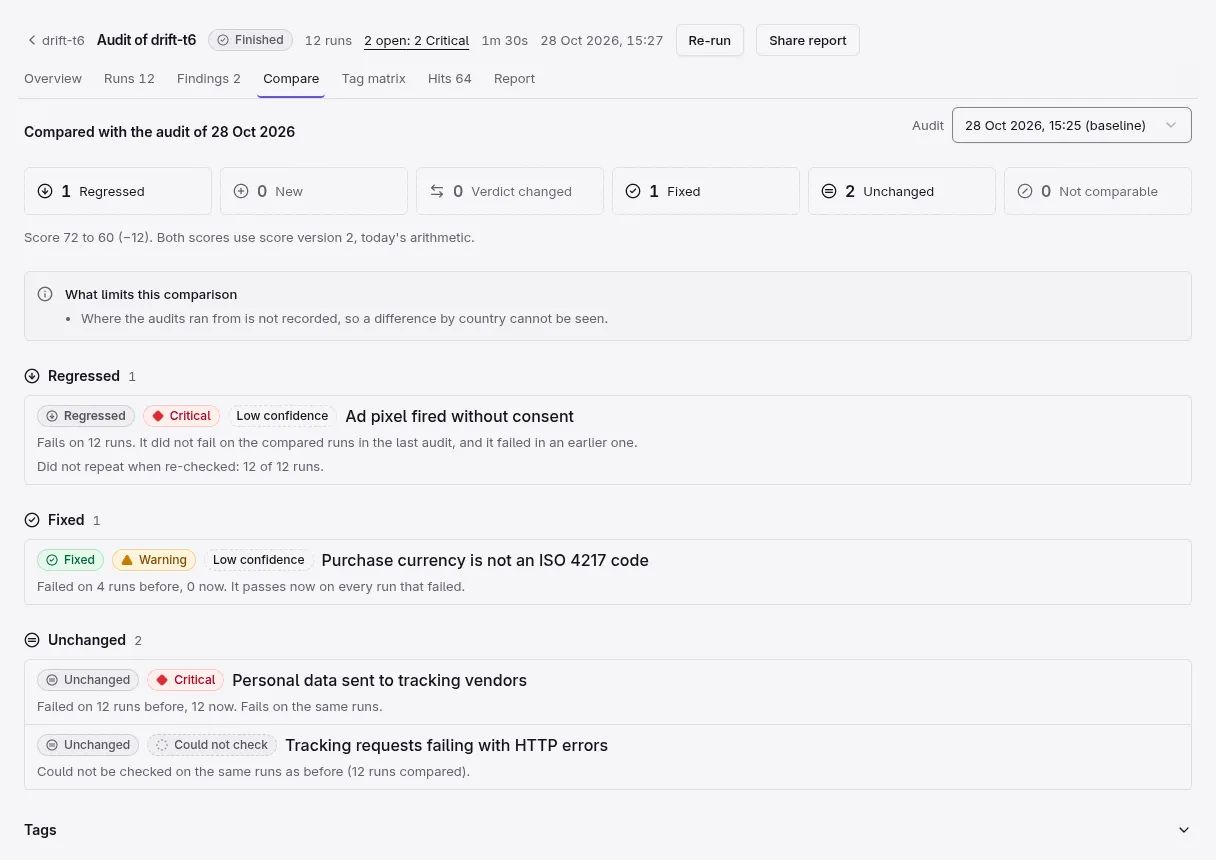
- Re-run and compare. A re-run is compared with the audit it came from, cell by cell, so you can see what was fixed, what is new, and what came back.
- A white-label report with the organization’s logo and accent color, shared through a link that can be revoked.
Architecture
Audit workflow
Cloudflare Workflows
Capture engine
Container, Chromium
Decoders
request → hit
Rules
28 checks
Findings and report
- The web app is TanStack Start on Cloudflare Workers, with the server side written in Effect. It was scaffolded with efforge.
- Audits run as a Cloudflare Workflow. A Durable Object streams live progress to every open tab of that audit.
- The capture engine runs in a Cloudflare Container. It’s a Node server that drives Chromium through a Python child process (Scrapling), and every browser connection goes through an egress proxy that blocks private addresses.
- Raw captures and screenshots go to R2 and are never changed. Hits, checks, and findings are derived from them into Postgres.
Decisions and trade-offs
- Rules decide, the LLM explains. Every check is a deterministic function over the captured data. An LLM can write explanations and fix steps using a key the organization brings itself, but it never decides pass or fail, and every check works without it.
- “Could not check” is an answer. When Zinko can’t tell, for example because it couldn’t find the cookie banner, the finding says so instead of passing. A re-run marks something fixed only when it passes every run that failed before.
- Postgres over D1. D1 would have been simpler on Cloudflare, but Postgres keeps a self-hosting path open outside Cloudflare.
- AGPL-3.0. Anyone who runs a modified Zinko as a service has to share their changes.
Status
A release candidate for v0.1. It works end to end locally and has completed a one-page audit on Cloudflare. Capture time at scale and the capture container’s cold start on Cloudflare aren’t measured yet.